What Changed on 60 Meters in 2026?
The 60 meter ham radio band 2026 changes give U.S. amateur operators something they have wanted for years: continuous secondary amateur access from 5351.5 to 5366.5 kHz. The FCC rule changes took effect February 13, 2026, and they sit alongside four retained discrete 60-meter channels outside that new segment.
The most important practical point is this: 60 meters is still not a normal HF band like 40 or 20 meters. It is shared spectrum, amateur stations are secondary, and the power and frequency rules require more care than simply spinning the VFO and calling CQ. The new segment adds flexibility for CW, digital, weak-signal work, emergency practice, and voice, but every signal must stay inside the applicable limits.
For official details, check the current ARRL 60 Meter FAQ, the ARRL 60-meter channel allocation page, the FCC Report and Order at FCC-25-60A1, and the Federal Register rule publication at 90 FR 2026-00587.
Who May Use 60 Meters?
Under U.S. amateur rules, 60-meter privileges are for General, Advanced, and Amateur Extra class licensees. Technician and Novice licensees do not receive these HF privileges simply because the new segment exists.
U.S. amateur stations operate on 60 meters on a secondary basis. That means you must not cause harmful interference to primary users, including federal users, and you must accept interference from them. If you hear traffic that appears to be non-amateur or official, do not argue, tune up, call over it, or try to “hold” a frequency. Move away.
The New Continuous Segment: 5351.5–5366.5 kHz
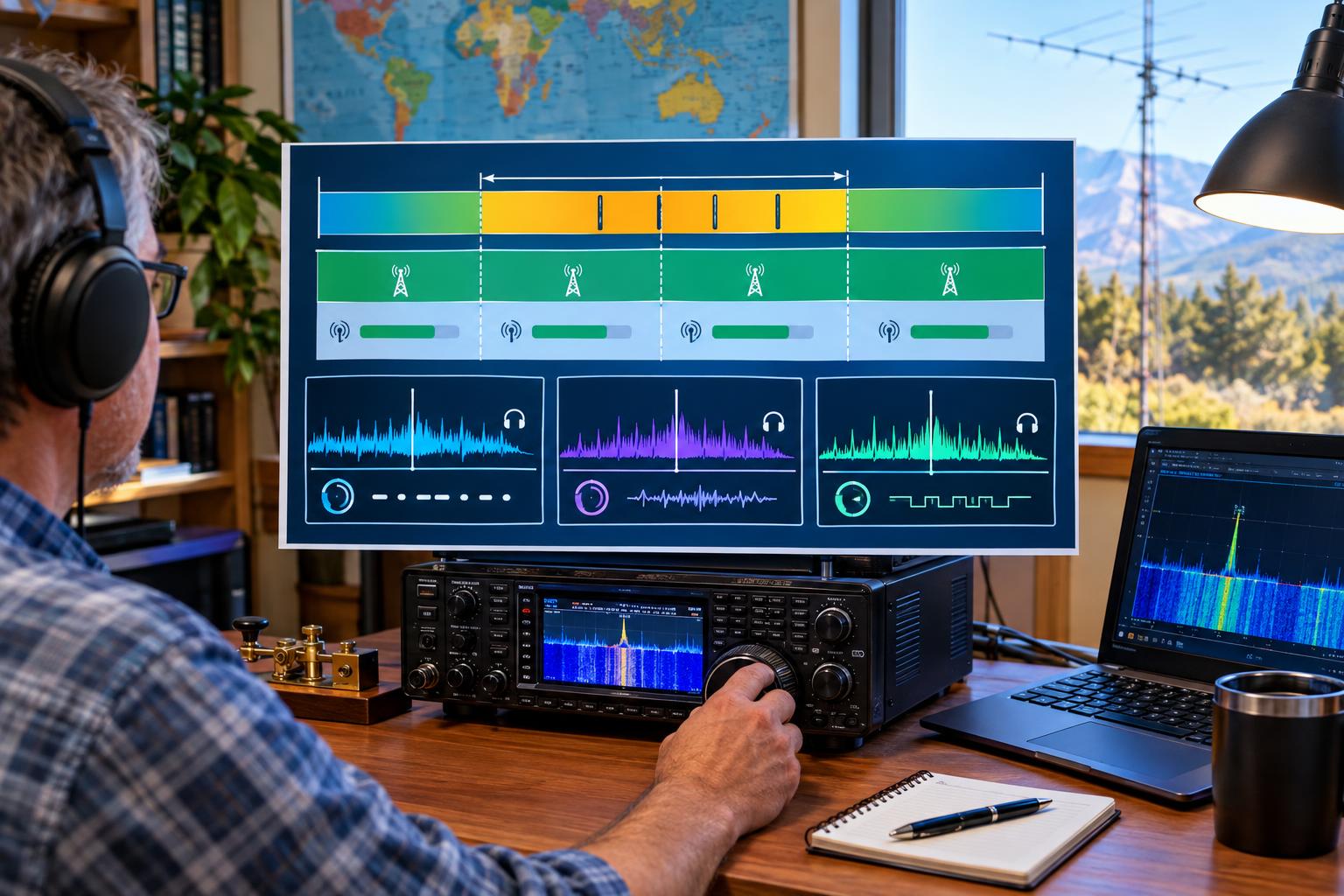
The new amateur segment is 15 kHz wide, from 5351.5 kHz to 5366.5 kHz. Unlike the older channelized structure, this is continuous spectrum. You may tune within it, but your entire occupied signal must remain inside the segment.
That last sentence is the trap. Your radio display is not always the same thing as the actual RF energy your station is transmitting. With USB voice and many sound-card digital modes, the transmitted RF appears above the displayed suppressed-carrier frequency. With CW, many radios display the actual carrier frequency, but settings vary. With digital modes, the audio offset in your software matters.
Practical USB Voice Tuning
For upper sideband voice, your audio energy is above the dial frequency. If your transmitted audio occupies roughly 300 to 2700 Hz, a dial setting too close to the top edge can put part of your signal outside the band.
A conservative approach is to keep ordinary USB voice dial frequencies no higher than about 5363.7 kHz if using a 2.8 kHz transmit bandwidth, and to leave additional guard room near both edges. Narrowing your transmit audio bandwidth helps, but do not rely on optimistic menu settings unless you understand your rig’s transmit filtering.
Practical Digital Tuning
For audio-derived digital modes on USB, the RF frequency equals:
RF frequency = radio dial frequency + audio offset
Example: if your radio dial is 5357.0 kHz and your digital software transmits at a 1500 Hz audio offset, the RF energy is centered around 5358.5 kHz. That is inside the new segment. This example is not a universal calling frequency recommendation; it simply shows how the math works.
Before transmitting FT8, JS8, Olivia, PSK, packet, VARA HF, or any other mode, confirm both the low and high edges of the occupied signal. A narrow mode is easier to place safely. Wider data modes demand more guard space and more attention to the 2.8 kHz emission bandwidth limitation commonly associated with 60-meter operation.
Practical CW Tuning
For CW in the continuous segment, make sure the actual transmitted carrier is within 5351.5–5366.5 kHz. Most modern transceivers display the CW carrier frequency, but operators should verify how their radio behaves in CW, CW-R, split, and transverter-style configurations. When in doubt, leave margin from the band edges.
The Four Retained Channels Outside the Segment
The 2026 rules did not simply replace all old 60-meter operation with one continuous segment. Four discrete channels remain outside the new 5351.5–5366.5 kHz segment. The commonly referenced channel center frequencies are:
- 5332.0 kHz center frequency; typical USB dial: 5330.5 kHz
- 5348.0 kHz center frequency; typical USB dial: 5346.5 kHz
- 5373.0 kHz center frequency; typical USB dial: 5371.5 kHz
- 5405.0 kHz center frequency; typical USB dial: 5403.5 kHz
The old 5358.5 kHz channel is the source of much confusion because it falls inside the new continuous segment. Treat operation there as operation within the new segment, not as a separate high-power legacy channel. Check the current ARRL and FCC references before relying on any memorized pre-2026 channel list.
Power Limits: Radio Output Is Not the Same as ERP or EIRP
Power is where many operators can accidentally break the rules. Your transceiver’s power control shows transmitter output power, not the radiated power limit used in the rules.
The new 5351.5–5366.5 kHz segment is associated with a 15-watt EIRP limit. EIRP means equivalent isotropically radiated power, referenced to an ideal isotropic radiator. By contrast, older U.S. 60-meter channel rules have commonly used ERP, or effective radiated power, referenced to a half-wave dipole.
The conversion matters because a half-wave dipole has about 2.15 dB gain over an isotropic radiator in its favored direction. As a result, 15 watts EIRP is about 9.1 watts ERP. This does not mean your radio must always be set to 9 watts. It means your final radiated-power calculation must account for antenna gain and feed-line loss.
Simple EIRP Calculation
Use this practical formula:
EIRP in watts = transmitter power × 10^((antenna gain in dBi − feed-line loss in dB) / 10)
Example: suppose your transmitter is set to 10 watts, your antenna is a half-wave dipole with about 2.15 dBi gain, and your feed line loss is 1 dB. The net gain is 1.15 dB. Your EIRP is about 10 × 10^(1.15/10), or roughly 13 watts EIRP. That is under 15 watts EIRP.
If the same dipole had nearly no feed-line loss, 10 watts transmitter output would be about 16.4 watts EIRP, which is above 15 watts EIRP. A conservative operator using a dipole in the new segment may choose a transmitter setting around 5 to 8 watts unless a more careful station calculation supports a higher setting.
Do not assume low SWR makes you legal. SWR tells you about impedance matching, not radiated power compliance.
Mode Setup Without Splattering Outside the Segment
Digital and Weak-Signal Modes
Digital modes are attractive on 60 meters because the 15-watt EIRP limit rewards efficiency. Use clean audio drive, keep ALC action minimal or absent for sound-card modes, disable speech processing, and avoid overdriving the radio’s USB input. A narrow, clean 5-watt digital signal is far more useful than a distorted one at the legal edge.
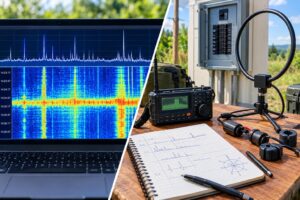
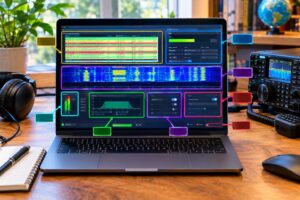
For weak-signal operation, set your waterfall range so you can see where your signal sits relative to the segment edges. If the software shows audio tones from 200 to 2800 Hz, remember that those tones are added to the radio dial frequency in USB. Keep both edges inside the allowed spectrum.
CW
CW is well suited to the new segment because it is narrow and efficient. Use reasonable keying speed, clean key shaping if your rig offers it, and avoid tuning right on the band edges. If you use an external keyer, amplifier, or QRP transmitter, verify that the displayed or selected frequency corresponds to the transmitted RF carrier.
Voice
Use USB, keep transmit audio bandwidth appropriate, and avoid excessive compression. On 60 meters, loudness is not the goal; a clean, intelligible signal is. If your radio has transmit equalization, avoid heavy bass that consumes bandwidth without improving readability.
Propagation: Why 60 Meters Is Useful
60 meters sits between 80 and 40 meters, which makes it valuable for regional communication. It can support NVIS-style paths of a few hundred miles when conditions cooperate, especially with horizontal antennas at moderate heights. It may also provide longer paths at night or around gray-line periods, but it is not magic and it is not always open.
Space weather matters. High solar activity can improve higher HF bands while D-layer absorption, geomagnetic storms, and nighttime ionospheric changes affect 5 MHz paths differently. For emergency and off-grid planning, do not treat 60 meters as a guaranteed link. Test multiple bands, maintain alternate modes, and keep realistic schedules with stations you are authorized to contact.
Emergency and Off-Grid Operating Considerations
The 5 MHz region is useful for emergency communications because it can bridge the gap between local VHF/UHF coverage and longer HF paths. However, amateur use remains secondary, and emergency intent does not erase the rules. Use the minimum power necessary, identify properly, log important tests, and avoid interfering with non-amateur users.
For field stations, a simple 60-meter dipole, inverted-V, or end-fed antenna can work well, but power calculations still apply. Battery voltage changes, tuner losses, feed-line type, and antenna placement all affect real-world performance. Also consider RF exposure compliance, safe generator placement, grounding and bonding, trip hazards, weather exposure, and lightning risk. No portable contact is worth an unsafe installation.
Quick Operating Checklist for 2026
- Confirm you hold General, Advanced, or Amateur Extra privileges.
- Use 5351.5–5366.5 kHz only with the entire signal inside the segment.
- Remember that the old 5358.5 kHz channel is now within the continuous segment.
- Use the four retained channels only as channels, not as open mini-bands.
- Calculate EIRP or ERP as applicable; do not rely only on radio output power.
- For digital modes, add audio offset to dial frequency to find RF frequency.
- For USB voice, leave enough room below 5366.5 kHz for your full audio bandwidth.
- Operate secondary: move if you encounter primary-user activity.
- Keep signals clean, narrow, and no stronger than needed.
- Recheck FCC and ARRL guidance because operating details can change.
FAQs
Can I use my old 60-meter memories?
Maybe, but review every memory. Old channel memories may still be useful for retained channels, but the former 5358.5 kHz channel should be understood in light of the new continuous segment and its power limit.
Is 15 watts EIRP the same as setting my radio to 15 watts?
No. EIRP includes antenna gain and feed-line loss. A dipole with little feed-line loss can exceed 15 watts EIRP with a 10-watt transmitter setting. Calculate conservatively.
Can I run FT8 or JS8 on 60 meters?
Digital operation can fit the new segment when the mode, bandwidth, dial frequency, audio offset, and power all comply with the rules. The operator is responsible for keeping the full signal inside the authorized spectrum.
Is 60 meters good for emergency communications?
It can be very useful for regional HF, especially when 80 meters is too low and 40 meters is too high for the desired path. But propagation varies, amateur use is secondary, and emergency planning should include alternate bands and modes.
Key Takeaways
The 2026 60-meter changes give U.S. hams more flexibility, especially for narrow digital modes, CW, weak-signal work, and regional emergency practice. The tradeoff is responsibility: know whether you are in the continuous segment or on a retained channel, calculate radiated power correctly, and keep your entire signal inside the authorized limits. When in doubt, reduce power, narrow your signal, leave more guard space, and check the current FCC and ARRL references before transmitting.