Why “Q65 EME receive first” is the right plan for a modest station
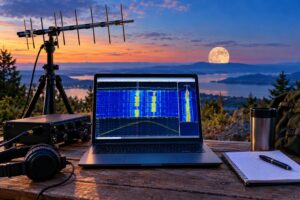
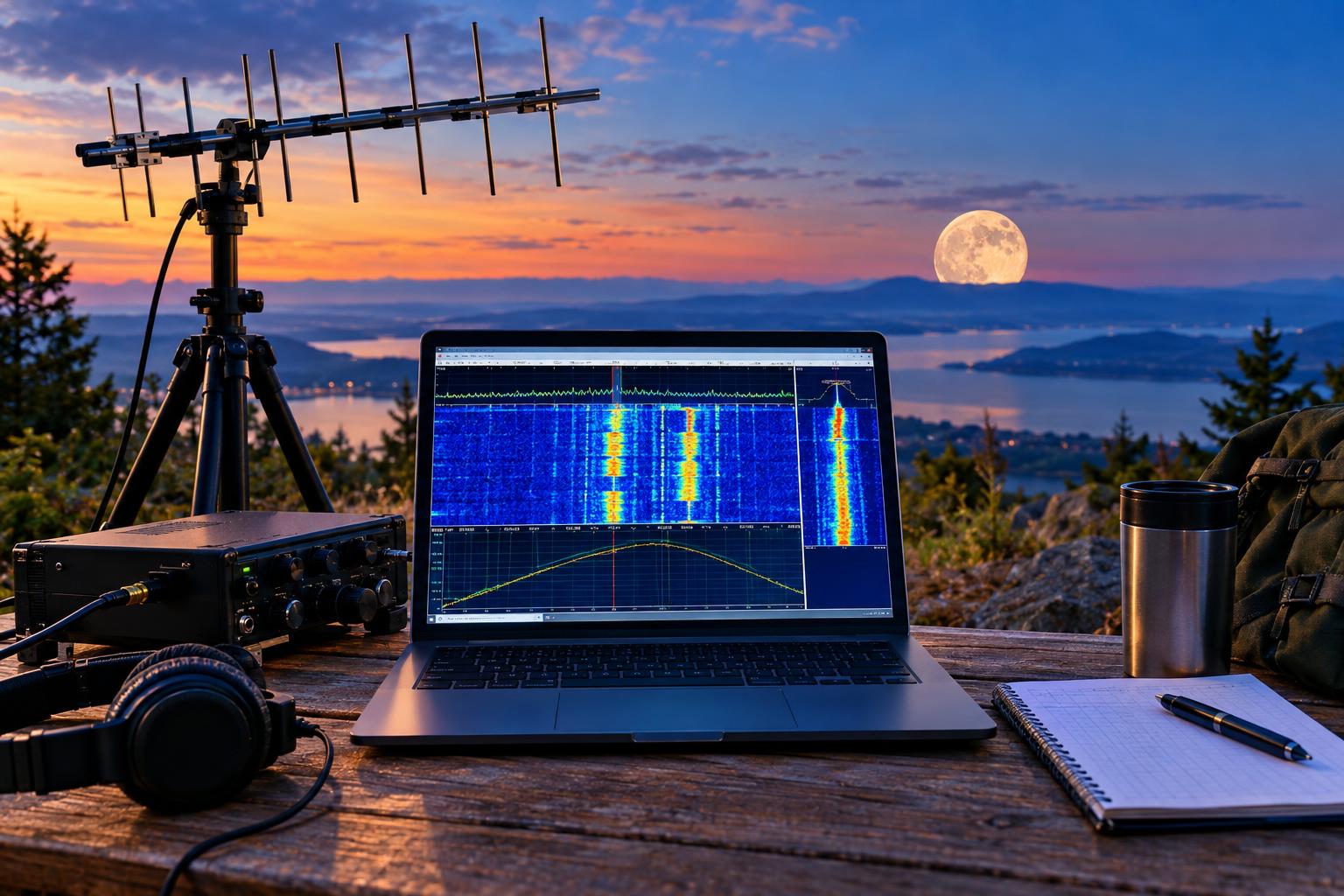
Moonbounce is one of the most demanding weak-signal activities in amateur radio, but the best first step is not buying a larger amplifier or immediately calling CQ. It is listening. A Q65 EME receive first approach lets you verify the things that matter before you transmit: time synchronization, receive noise, Doppler correction, moon visibility, antenna pointing, polarization, audio levels, and whether your station is realistically in the game.
That matters even more before a busy weekend. The ARRL lists its 2026 EME 50–1296 MHz contest weekend for November 28–29, with logs due December 29. Contest activity can put more capable stations on the moon, which is useful for receive testing. Before operating, always confirm the current official schedule and rules on the ARRL contest pages because rules, categories, and deadlines are controlled by the sponsor.
EME is different from meteor scatter even though both live in the advanced VHF/UHF weak-signal world. Meteor scatter often rewards quick bursts and good timing around ionized trails. EME is a deliberate two-way path: your signal travels to the moon, reflects weakly, and returns to Earth. The round trip is roughly 2.5 seconds, path loss is severe, and Doppler shift can be significant, especially as frequency increases. That is why receiving first is not timid; it is the technically correct way to learn whether your station is ready.
Start with the operating target and band reality
For a modest station, the most realistic first EME listening bands are often 144 MHz and 432 MHz, with 1296 MHz possible for better-equipped stations. Lower VHF is more forgiving of pointing accuracy than microwave bands, but it is still not easy. Your actual chance of decoding depends on antenna gain, feed-line loss, receiver noise figure, local noise, moon elevation, degradation, polarization, Doppler handling, and the transmitting station’s capability.
Do not treat a single “minimum station” recipe as universal. A quiet location with a good low-noise preamp at the antenna may outperform a higher-power urban station with long lossy coax and local RFI. A modest station should aim first to decode known, strong EME stations during periods of activity, not to complete random contacts immediately.
Build the receive-first checklist
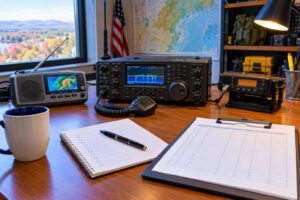
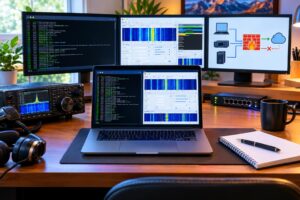
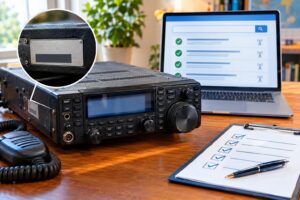
Before the contest weekend, set up a repeatable receive test. The goal is to remove avoidable errors so that a failure to decode means something useful.
- Confirm station timing: Use reliable time synchronization. Q65 decoding depends on accurate computer time, and even small timing errors can ruin decodes.
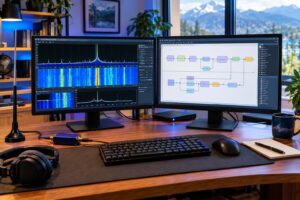
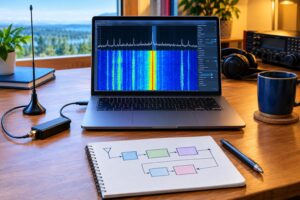
- Update and learn your software: WSJT-X supports Q65 and provides tools used for weak-signal work, including frequency and Doppler-related functions. Use the official documentation rather than copied screenshots from old versions.
- Check audio levels: Keep receive audio in a clean range with no clipping. Overdriven waterfall audio can look busy while decoding poorly.
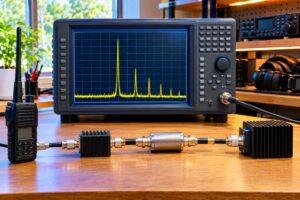
- Measure local noise: Compare antenna connected, dummy load, and preamp on/off conditions if your station permits. The receiver should hear the antenna noise environment, not only internal noise.
- Reduce feed-line loss: At VHF and UHF, coax loss matters. A mast-mounted preamp can help, but only if protected from transmit RF and weather.
- Plan moon windows: Know when the moon is visible from your location and clear of trees, buildings, or terrain. Low elevation may add ground clutter and obstruction.
- Know your band plan and privileges: Technical capability does not equal legal permission. Confirm your license privileges, frequency allocations, and current local rules.
Q65 basics for EME listening
Q65 is a weak-signal mode in WSJT-X intended for difficult propagation paths, including EME. It uses structured messages, synchronized transmit/receive periods, and strong error correction. Compared with old casual voice-style tuning, Q65 rewards precision. If the other station is not where your software expects it in time and frequency, you may see energy but get no decode.
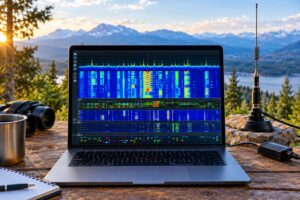
For EME, operators commonly use scheduled periods and agreed submodes suited to the band and path. Do not guess blindly. Before the weekend, read the WSJT-X documentation, watch current operating practice on the band you intend to monitor, and observe how active stations format their transmissions. The receive-first goal is to decode real signals, not merely see traces on a waterfall.
What a successful receive test proves
A clean Q65 decode from an EME station tells you several important things. Your clock is close enough. Your receiver chain is functioning. Your frequency calibration is close enough for the decoder. Your antenna is pointed well enough. Your local noise is not completely overwhelming the path. It does not prove that your transmitted signal will be heard, but it gives you a foundation for deciding whether calling is reasonable.
What a failed receive test does not prove
No decode does not automatically mean your station is hopeless. You may be listening at a poor moon position, during low activity, with incorrect Doppler settings, wrong period, wrong submode, blocked horizon, excessive local noise, or frequency offset. Treat failures as diagnostic clues.
Doppler: the step modest stations cannot skip
EME signals shift in frequency because of changing relative motion between your station, the moon, and the other station. Doppler shift increases with frequency. On 144 MHz it may be manageable but still important for narrow digital modes. On 432 MHz it is larger. On 1296 MHz it can be large enough that casual tuning becomes frustrating.
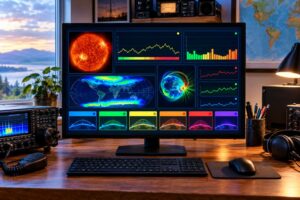
Before the November 28 weekend, practice predicting and compensating for Doppler. In WSJT-X, study the program’s EME-related controls and documentation. The exact settings and best practice can change by software version, so rely on the current official WSJT-X user guide rather than memory. The practical questions are simple: Where should I tune? Is the displayed frequency corrected? Am I decoding the other station at the expected offset? Am I calling where the other operator will be listening?
If your receiver has frequency error, Doppler correction and rig calibration interact. A transceiver that is several hundred hertz off may still work in some situations but can make first EME attempts much harder. Use known references, local beacons where appropriate, or disciplined frequency standards if available. At minimum, avoid assuming the dial is perfect.
A practical receive session before the contest
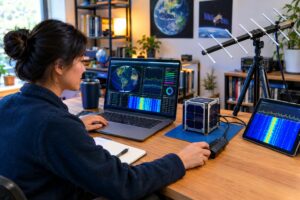
Run at least one full receive-only session before you decide to transmit. Pick a time when the moon is visible and activity is likely. Open your logging program or notebook, but focus on observations rather than contact chasing.
- Step 1: Record your band, antenna, preamp state, feed line, software version, and approximate weather or obstruction conditions.
- Step 2: Synchronize the computer clock and confirm it remains stable.
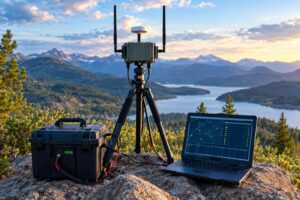
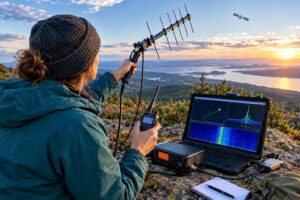
- Step 3: Point the antenna at the moon using your chosen tracking method. If you use fixed elevation, note where the moon passes through your usable beamwidth.
- Step 4: Tune to an appropriate EME activity area consistent with current band practice and your license privileges.
- Step 5: Configure Q65 period and submode to match what active stations are using.
- Step 6: Watch several complete receive periods before changing settings. Weak-signal work punishes constant knob turning.
- Step 7: Note any decodes, partials, visible traces, noise bursts, birdies, or interference.
- Step 8: Change only one variable at a time: antenna heading, elevation, preamp, bandwidth, frequency, or Doppler setting.
One disciplined receive session can reveal more than an evening of random calling. If you decode several known EME stations at plausible signal levels, you are approaching the point where a carefully chosen first call may make sense.
When is it reasonable to call?
Transmit only after your receive performance, legal status, and station safety are in order. A modest station should call when the path and operating situation favor success, not simply because a contest weekend is busy.
It may be reasonable to try calling if you can decode the station reliably, understand the exchange format, have Doppler under control, know which sequence to transmit in, and can operate within your license privileges and equipment limits. It is usually better to answer a strong, active station than to call CQ with an unproven station.
It is not yet reasonable to call if you cannot decode anyone, do not know whether your clock is correct, have not checked transmit audio and ALC behavior, are unsure of the correct frequency, or have not evaluated RF exposure and station safety. Calling blindly adds confusion and does not help you learn efficiently.
Transmitting safely and cleanly
EME often tempts operators toward high power, but every station must remain safe and compliant. Review RF exposure requirements that apply to your jurisdiction, especially with directional antennas and elevated duty-cycle digital modes. Keep people out of controlled areas near antennas. Make sure coax, relays, preamps, sequencers, and connectors can handle the power and switching sequence.
Sequencing is especially important if you use a mast-mounted preamp. The preamp must be protected from transmit power. A good EME station may use sequencing so the amplifier, transceiver, antenna relay, and preamp switch in a safe order. Hot-switching relays or transmitting into the wrong path can destroy equipment quickly.
Also watch digital transmit levels. Avoid excessive ALC action and splatter. Q65 is a weak-signal mode, not an excuse for overdriven audio. Clean RF helps everyone on a crowded weekend.
Contest weekend etiquette for first attempts
A busy EME contest weekend can be a good learning opportunity, but it is also a time when operators are trying to complete valid contacts efficiently. Read the rules before operating. Know the exchange, band limits, assistance rules, and log requirements if you plan to submit a log.
If you are experimenting, be considerate. Listen first. Do not repeatedly call a station you cannot decode. Do not transmit on top of an ongoing contact. Keep messages standard unless there is a good reason not to. Log accurately, including date and UTC time. If you are not confident a contact was completed, do not embellish it.
Common receive-first problems and fixes
No waterfall signal and no decodes
Check that the moon is actually visible to your antenna, the feed line is connected, the preamp has power, and the radio is on the correct band and mode. Confirm that software audio is coming from the correct device.
Waterfall traces but no Q65 decodes
Check clock synchronization, period timing, submode, frequency offset, and Doppler correction. Let several periods pass before changing settings. If traces drift, frequency stability may be part of the problem.
Intermittent decodes only
That can be normal with marginal signals, polarization mismatch, libration fading, obstruction, or local noise. Improve pointing, reduce loss, and compare different moon elevations.
Good receive results but no replies
Your transmit EIRP may be too low, Doppler on transmit may be wrong, polarization may be unfavorable, or you may be calling at a poor time. Recheck transmit audio, power, SWR, sequencing, and whether the other station is working someone else.
Key takeaways
- Receive first: Decoding Q65 before transmitting is the fastest way to find real station problems.
- Doppler matters: The higher the band, the less forgiving frequency error becomes.
- Activity helps: The November 28–29 ARRL EME weekend can provide more signals to study, but always verify current rules and dates.
- Do not call blindly: Call only when you can decode, understand the sequence, and operate safely and legally.
- Modest stations can learn a lot: Even without a completed contact, receive-only EME testing improves weak-signal skill.
FAQ
Can I try EME with a small VHF/UHF station?
You can usually try listening, and listening is the right first step. Completing contacts depends on antenna gain, noise, power, feed-line loss, preamps, Doppler control, and activity. Start by decoding stronger stations.
Is Q65 only for EME?
No. Q65 is used for difficult weak-signal paths, including EME and other propagation modes. For meteor scatter, operators may use different modes and practices depending on band and conditions.
Do I need automatic antenna tracking?
Automatic azimuth and elevation tracking helps, especially at higher frequencies and with narrow beams. Some modest stations can receive during limited moon windows with manual pointing or fixed elevation, but they must understand beamwidth and obstruction limits.
Should I submit a contest log for my first EME weekend?
If you make valid contacts and follow the rules, you can consider submitting a log. Read the official ARRL rules first, and do not log incomplete or uncertain contacts as completed QSOs.