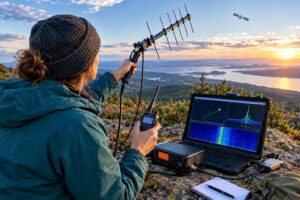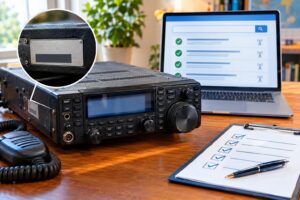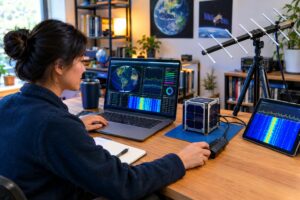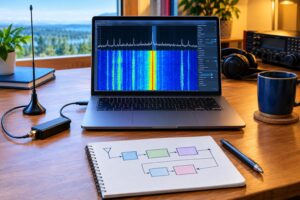
Direct-to-device satellite proposals have moved the microwave noise-floor discussion from an abstract policy issue into the ham shack. For amateur satellite operators, microwave experimenters, and weak-signal VHF/UHF enthusiasts, the practical question is simple: what can you document before the record closes?
FCC ET Docket 26-169 has a reply-comment deadline of Dec. 7, 2026, according to the Federal Register notice. AMSAT filed comments on Nov. 9, and amateurs who use the 2.4 GHz and 5.8 GHz neighborhood should understand how to produce useful, technically credible observations without overstating what a home station can prove.
This article focuses on measurement practice: how to record your local S-band and 5 cm noise environment, how to separate shack-generated interference from outdoor signals, and how to turn observations into concise, defensible documentation. It is not legal advice, and it does not assume that every station has laboratory equipment.
Why 2.4 GHz and 5.8 GHz Matter to Amateur Satellite Operators
The 2.4 GHz range sits in the practical world of S-band receiving, Wi-Fi, Bluetooth, microwave links, consumer electronics, and amateur satellite downlinks or uplinks depending on the specific service and band segment. The 5.8 GHz region, often discussed by hams as part of the 5 cm amateur band, is also shared with unlicensed devices, point-to-point links, video equipment, and other services.
That crowded environment matters because satellite and weak-signal work is often limited not by transmitter power but by receiver system noise. A satellite signal may be readable only because the receiving system, feed line, preamp, antenna, and local environment are quiet enough. Raise the local noise floor, and signals that were once workable can disappear into a broader hash.
For hams, the phrase amateur 2.4 GHz satellite interference should not be reduced to a complaint about one device or one proposed system. The better question is: what is the measurable noise and signal environment at your station, using a described antenna, receiver, bandwidth, time, and location?
What You Can and Cannot Prove From a Home Station
A home station can document local conditions very well. It can show recurring noise sources, broadband increases, time-of-day patterns, azimuth differences, and the effect of turning local equipment on and off. It can also show whether your own router, power supply, USB cable, monitor, LED lighting, mast preamp, or computer is contaminating your receive setup.
A home station generally cannot prove a nationwide interference impact by itself. It also cannot identify a specific satellite network unless you have appropriate signal characteristics, timing, direction finding, and corroborating information. Avoid claims that go beyond your data. A useful filing says, in effect: “Here is what I measured, here is how I measured it, and here is why additional aggregate noise in this band would be harmful to weak-signal amateur reception.”
That restraint makes your comments stronger. Regulators and technical reviewers are more likely to value observations that include repeatable methods, screenshots, units, and limitations than broad claims without supporting detail.
Minimum Measurement Setup
You do not need a professional microwave lab to make useful observations, but you do need consistency. At 2.4 GHz and especially at 5.8 GHz, small setup changes can create large differences.
Practical equipment list
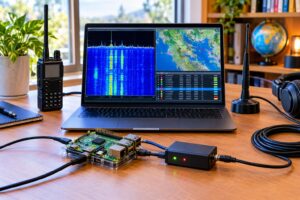
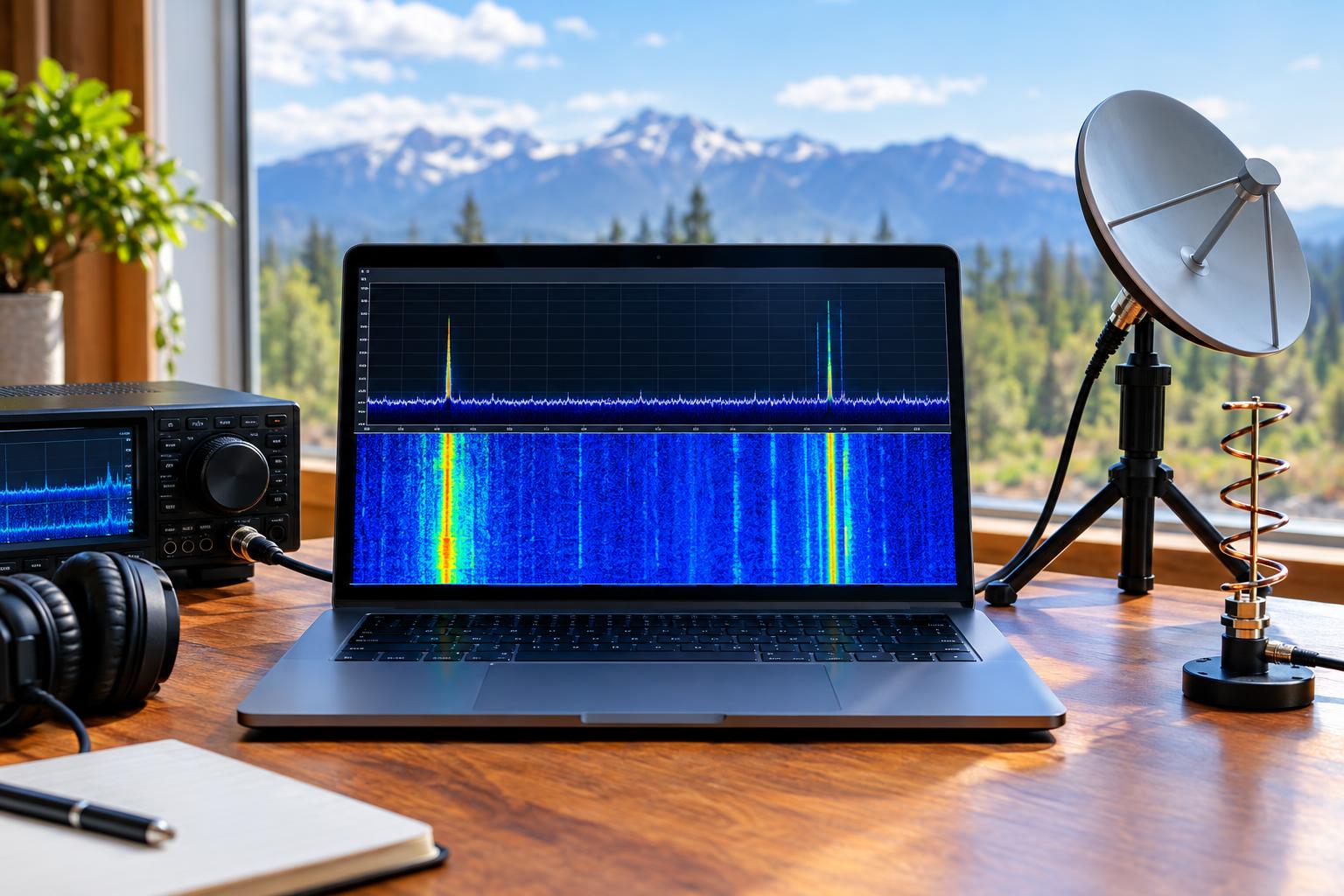
- SDR or spectrum analyzer: Use equipment that actually covers the frequency range of interest. Many inexpensive SDRs do not reach 5.8 GHz without a converter.
- Stable antenna: A patch, dish feed, helix, small yagi, or known broadband antenna is better than an unknown random whip.
- Short, appropriate coax: Microwave feed-line loss is significant. Use good coax, keep it short, and document the type and approximate length.
- Optional low-noise amplifier: If used, place it near the antenna when practical and record its model or gain/noise specifications if known.
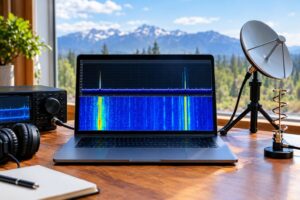
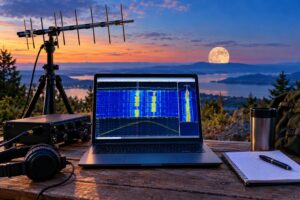
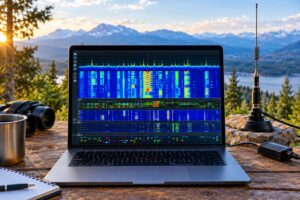
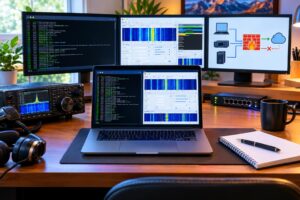
- Computer with screenshots or logging: Save waterfall images, spectrum captures, timestamps, frequency spans, and receiver settings.
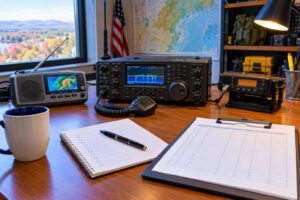
- Notebook or station log: Record the physical setup, weather if relevant, antenna direction, local devices on/off, and any visible changes.
If your receiver requires a downconverter for 5.8 GHz, document the local oscillator frequency and whether your displayed frequency is corrected. Frequency errors are common in microwave monitoring and can weaken otherwise useful observations.
Choose Frequencies and Bandwidths Carefully
Do not simply open a wide waterfall and take a dramatic screenshot. Wide spans are useful for finding activity, but noise-floor documentation is more persuasive when the span, resolution bandwidth, and center frequency are controlled.
For 2.4 GHz work, make observations both near frequencies you actually use and across nearby occupied areas. For 5.8 GHz, do the same within the range your equipment and license privileges allow you to receive. Receiving is generally less restricted than transmitting, but transmitting, satellite operation, and band use are governed by current FCC rules, allocations, and accepted band plans. Always verify the present Part 97 rules and applicable band-plan guidance before transmitting.
Suggested capture types
- Baseline narrow capture: A narrow span around a frequency of amateur interest, saved at several times of day.
- Wide survey capture: A wider span to show nearby broadband or channelized activity.
- Antenna-direction capture: The same settings while pointing the antenna in several azimuths and elevations.
- Local-device capture: The same settings with shack network gear, chargers, displays, LED lights, and other devices turned off and then on.
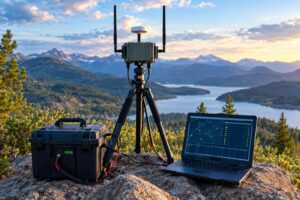
- Outdoor comparison: If safe and practical, repeat from a yard, driveway, or portable site away from the shack wiring.
For each capture, keep the receiver gain setting fixed. Automatic gain control can hide real changes by turning the receiver gain down when signals get stronger. If your software allows it, disable AGC and record gain values.
Find Your Own Shack Noise First
Before submitting a comment about external interference, make sure your own station is not the dominant problem. Microwave receive systems are often affected by things that seem unrelated to radio.
Start with a normal receiving setup and note the displayed noise floor. Then shut down nonessential devices one category at a time: Wi-Fi router, Ethernet switch, laptop charger, USB hub, monitor, solar charge controller, battery charger, LED lamps, switching power supplies, and nearby consumer electronics. Let the waterfall settle after each change.
If the noise drops when one device is unplugged, document that separately. Do not mix local RFI cleanup with external noise-floor evidence. In fact, including a sentence such as “local device checks were performed; no observed change greater than the visible display variation occurred” can make your measurement note more credible, provided it is true.
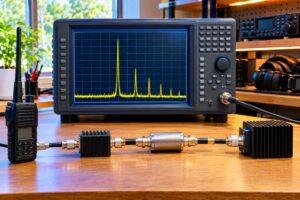
Common microwave measurement pitfalls include overloaded SDR front ends, loose SMA adapters, poor shielding, USB noise entering through the receiver, and mistaking receiver gain changes for real RF changes. A simple control is to terminate the receiver input with a 50-ohm load, if you have one, and observe whether the displayed noise changes compared with the antenna connected. That does not calibrate the system by itself, but it helps distinguish receiver-internal behavior from antenna-received energy.
How to Record Useful Noise-Floor Observations
A good observation is not just a picture. It is a picture plus enough information for another technically competent person to understand what it represents.
Include these details
- Date and local time: Include time zone.
- General location: City and state are usually enough for public comments; avoid publishing sensitive personal details unless you choose to.
- Frequency range: Center frequency and span, or start and stop frequencies.
- Receiver and software: Identify the SDR or analyzer and the software used, without implying laboratory calibration if none exists.
- Antenna: Type, approximate gain if known, polarization, height, and pointing direction.
- Feed line and preamp: Coax type and length, preamp placement, filters, attenuators, and converters.
- Settings: Gain, sample rate, resolution bandwidth or FFT settings if available, averaging, and AGC status.
- Observation: What changed, by how much if your instrument supports reliable units, and under what conditions.
If your SDR display is not calibrated in dBm, avoid pretending it is. You can still document relative changes: “With the antenna pointed southwest, the displayed baseline rose approximately one major division compared with the northeast heading using identical gain and span settings.” If your analyzer is calibrated, state the bandwidth and detector or averaging mode so the reading has context.
Turn Measurements Into Strong Reply Comments
Reply comments are most useful when they respond to the record and explain practical consequences. You do not need to write like an attorney. You do need to be clear, brief, and technical.
A strong structure is:
- Who you are: Licensed amateur operator, satellite user, microwave experimenter, weak-signal operator, or other relevant role.
- What you operate: General station description, such as S-band satellite receive, 5 cm experimentation, EME interest, or portable microwave monitoring.
- Why low noise matters: Explain that satellite and weak-signal reception depends on preserving low aggregate noise and avoiding harmful interference.
- What you measured: Summarize your documented observations and attach or describe captures.
- What you request: Ask the FCC to protect existing amateur and amateur-satellite operations, require technically sound interference analysis, and consider aggregate effects on weak-signal reception.
Avoid exaggeration. Do not claim that all amateur satellite work will end unless your data supports that conclusion. Instead, explain that additional emissions, out-of-band energy, receiver desensitization, or aggregate noise could reduce margins for already weak signals, especially where amateurs operate on a secondary basis or share spectrum with other services.
Safety and Regulatory Caveats
Microwave work is not automatically dangerous, but it deserves respect. Use proper RF connectors, secure antennas, weatherproof outdoor equipment, and follow RF exposure requirements when transmitting. Do not climb roofs or towers just to obtain a measurement before a filing deadline. Portable receive-only observations from a safe location are better than unsafe work at height.
Regulatory status varies by exact frequency, service, and country. In the United States, consult current FCC rules, the applicable allocation table, and recognized amateur band-plan resources before transmitting. Amateur allocations in microwave bands often involve sharing and secondary status, so technical courtesy and legal compliance both matter.
Frequently Asked Questions
Do I need calibrated lab equipment to comment?
No. Calibrated equipment is helpful, but not required for a useful personal technical comment. Be honest about your equipment. Relative observations from a consistent setup can still show how fragile weak-signal reception is and why aggregate noise deserves careful treatment.
Should I upload raw SDR files?
Only if they are reasonably sized, well labeled, and necessary. In many cases, annotated screenshots plus a concise method description are more useful. Keep original files for your own records in case you want to re-check settings later.
What if my 2.4 GHz band is already noisy from Wi-Fi?
That is worth documenting. A noisy local environment does not mean additional interference is harmless. It may mean weak-signal operation already has little margin. Separate your own controllable sources from neighborhood or outdoor signals as carefully as practical.
Can I coordinate with other hams?
Yes. Multiple stations using similar methods can provide a broader picture, especially if they are in different RF environments. Each operator should still file accurate individual observations rather than copying unsupported claims.
Key Takeaways
- Document your present 2.4 GHz and 5.8 GHz noise environment before the ET Docket 26-169 reply-comment deadline.
- Use fixed receiver settings, clear timestamps, known antennas, and repeatable procedures.
- Check your own shack for local RFI before attributing noise to outside sources.
- State limitations honestly; do not turn home observations into claims they cannot support.
- Connect your measurements to the real operating issue: preserving weak-signal and amateur satellite reception margins.