Why “Bad QSOs” Happen in a Digital Contest
The ARRL Digital Contest rewards careful station setup as much as fast clicking. FT4, FT8, and other narrow digital modes make it easy to complete many contacts quickly, but they also make it easy to log the wrong grid, accept a broken exchange, mis-handle a duplicate, or submit a log that does not match the official requirements.
The most important preparation is not a bigger antenna or more power. It is building a contest workflow that follows the current ARRL Digital Contest rules, records the required exchange correctly, and produces a clean Cabrillo log for online submission. ARRL’s published information for this event emphasizes several points operators should treat as nonnegotiable: the exchange is a 4-character Maidenhead grid square, operation must be attended, and ARRL has noted that contest entries are online-only beginning September 30, 2026. Always verify the live rule page before operating, because contest rules can change.
Start With the Current Rules, Not Old Memory
Before configuring software, open the official contest page and calendar. Use the current rule document for the contest year you will operate, not a saved copy from a previous season. The ARRL Digital Contest is not simply “any FT8 weekend.” It has its own eligible modes, band rules, categories, exchange requirements, and log submission procedure.
When checking the rules, confirm the contest dates and times, eligible bands, permitted digital modes, entry category, power category, exchange, scoring method, and log deadline. Also confirm whether any special rule notes apply to remote operation, assistance, or software automation. Digital contesting changes quickly, and software defaults do not always match contest rules.
The Exchange: Send the Right 4-Character Grid
The key exchange item is your 4-character Maidenhead grid square, such as FN31, EM12, DM79, or CN87. A 4-character grid identifies a geographic area using two letters and two numbers. Many logging and weak-signal programs also support 6-character grids, but the contest exchange is the 4-character form unless the current rules state otherwise.
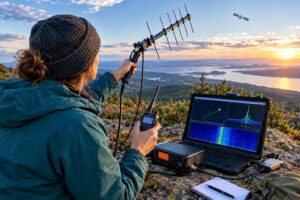
If your station location is fixed, enter the correct 4-character grid in every program involved in the contact chain: digital-mode software, contest logger, rig-control utility if applicable, and any log-conversion tool. If you operate portable, rover-style, from a temporary QTH, or through a remote station, verify which location the rules require you to use and set the grid accordingly before making contacts.
Common Grid Exchange Mistakes
- Using a home grid while operating portable: If the transmitter is somewhere else, your usual home-grid macro may be wrong.
- Sending six characters when four are expected: Some software may display your full locator. Make sure the transmitted contest exchange matches the rule requirement.
- Logging the other station’s old grid: Imported callbook or previous-contact data can conflict with the grid actually exchanged on the air.
- Typing letter-number lookalikes: Grids such as EN50 and EM50 differ by one letter but represent different areas.
- Changing grids mid-contest without tracking it: Portable operators must make sure the log reflects the correct exchange for each contact.
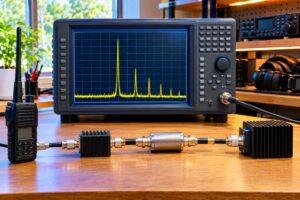
A good pre-contest habit is to transmit a practice message into a dummy load or monitor-only setup where appropriate, or use the software’s message preview, to confirm exactly what your station will send. Do not discover during the contest that your macro says “RR73” but never sends your grid.
Build an FT4/FT8-Style Contest Setup That Logs Cleanly
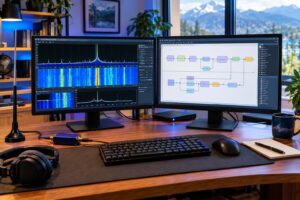
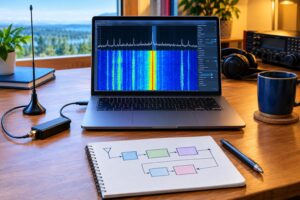
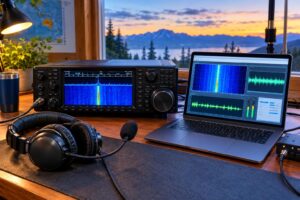
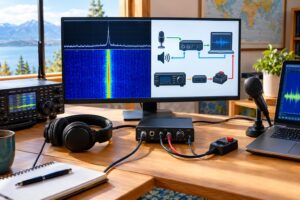
A reliable digital contest station has four layers working together: the radio, the audio interface, the digital-mode program, and the logger. A failure in any layer can create bad contacts or bad log data.
Radio and Interface Checks
- Confirm CAT control or manual band tracking so the log records the correct band.
- Set transmit audio drive conservatively to avoid overdriving the transmitter or creating unnecessary splatter.
- Use a clean, stable audio path and avoid unintended computer sound effects entering the transmit stream.
- Verify PTT control before the contest.
- Confirm your antenna system, feed line, and SWR are suitable for the bands you intend to use.
Computer and Clock Checks
FT4 and FT8 depend on accurate time synchronization. Before the contest, make sure your computer clock is being synchronized by a reliable time source. If your clock is off, other stations may not decode you reliably, and you may miss replies even though your transmitter and antenna are working.
- Disable sleep settings that could interrupt logging or time sync.
- Keep a backup copy of the log file during longer operating sessions.
- Record your exact software versions in your personal notes in case troubleshooting is needed later.
- Avoid making major software upgrades immediately before the contest unless necessary.
Attended Operation: Stay in Control of Every QSO
The ARRL Digital Contest rules emphasize attended operation. In practical terms, do not set up a station to call, answer, complete, or log contacts while you are away from the operating position. Digital software can automate parts of message sequencing, but contest compliance depends on the operator remaining present, responsible, and in control.
Attended operation matters because the operator must make judgment calls: whether the decoded call sign is correct, whether the exchange was actually received, whether a duplicate should be logged, whether the radio is still on an authorized frequency, and whether the station is transmitting a clean signal. A fully unattended digital station can generate questionable contacts quickly.
A Practical Attended-Operation Standard
- Be at the operating position and monitoring the software and radio behavior.
- Initiate or approve contacts as required by the rules and your entry category.
- Watch for wrong-grid, wrong-call, or partial-decode situations.
- Stop transmitting if the station behaves unexpectedly.
- Remain responsible for band privileges, RF exposure compliance, and station identification.
If you operate remotely, the same principle applies: the licensed control operator must remain actively in control, and the station must comply with applicable FCC rules, contest rules, and local station requirements. Technical capability does not automatically mean contest eligibility.
What Counts as a Contact You Should Log?
For a contest log, a QSO should represent a completed two-way exchange as required by the rules. Do not log a contact merely because you decoded a station, called it, or saw a partial message. You need enough information to support the required exchange and the correct station identity.
A cautious workflow for FT4/FT8-style operation is simple: decode the other station’s call, exchange the required contest information, confirm completion according to the mode’s message sequence and contest practice, then allow the logger to record the QSO. If something looks wrong, fix it before moving on.
Examples of QSOs to Review Before Logging
- Partial call sign: You decoded “K1ABC” once, but the following message looked like “K1ABD.” Resolve the call before logging.
- Missing grid: The contact completed with signal reports only, but the contest requires a grid. Do not assume a grid from a database.
- Band mismatch: The radio is on 20 meters, but the logger shows 15 meters because CAT control failed.
- Duplicate contact: The other station calls again on the same band. Check the current rules and your logger’s duplicate handling before deciding whether to log it.
- Wrong station answered: In crowded digital windows, another station may respond while your software still highlights the first one.
Logging: Make the Cabrillo File Match the Contest
Most contest submissions require a Cabrillo-formatted log generated by logging software or a contest-capable digital program. The exact header fields and QSO line format depend on the event. Do not hand-edit a Cabrillo file unless you understand the format, because a small mistake can create a rejected or misclassified entry.
Before exporting, check these items carefully:
- Your call sign is correct and consistently formatted.
- Your entry category, power, operator status, and station information match your actual operation.
- Each QSO has the correct date and UTC time.
- Each QSO has the correct band or frequency.
- The sent exchange is your correct 4-character grid.
- The received exchange is the other station’s actual received grid, not imported profile data.
- The mode field is appropriate for the contact and accepted by the contest log format.
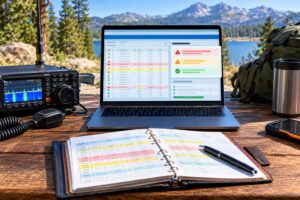
Save the original application log and the exported Cabrillo file. If your logger supports a log-check report, run it. Look for blank exchanges, impossible bands, duplicate records, time-order problems, and mismatched call signs. A clean log is not just about score; it is about accurately representing what happened on the air.
Online-Only Submission Planning
ARRL has noted that online-only contest submissions begin September 30, 2026. For the ARRL Digital Contest, plan your workflow around the online submission process rather than paper forms or informal email habits. The safest approach is to export the Cabrillo file immediately after the contest, review it, and submit it through the official ARRL contest submission system within the published deadline.
Online submission does not remove the need to inspect the file. The upload page may catch some errors, but it cannot know whether you sent the wrong grid, operated from the wrong category, or logged a contact that was not completed. Treat the upload confirmation as the final step, not the only step.
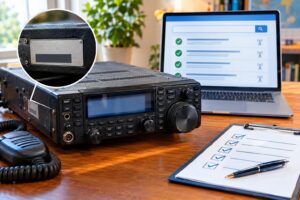
Post-Contest Log Checklist
- Export the log in the required format.
- Open the file in a plain-text editor and scan the header.
- Verify call sign, category, grid, power, and operator information.
- Confirm QSO times are in UTC.
- Check for blank or suspicious exchanges.
- Submit through the official online system.
- Save the confirmation or receipt for your records.
Safety and Regulatory Caveats
Digital modes can create long transmit periods at high duty cycle compared with casual SSB operation. Make sure your transmitter, amplifier, tuner, feed line, and antenna are rated for the duty cycle and power level you intend to use. Reduce power if equipment becomes hot, unstable, or distorted.
US operators must follow FCC rules, license-class privileges, band limits, station identification requirements, and RF exposure obligations. International operators should follow their own regulator’s rules. Contest rules do not override legal requirements. Also consider ordinary station safety: proper grounding and bonding, lightning precautions, safe antenna supports, and careful cable routing to prevent trips or equipment damage.
Key Takeaways
- The ARRL Digital Contest exchange centers on the correct 4-character Maidenhead grid.
- Do not rely on old settings, old PDFs, or software defaults without checking the current rules.
- Attended operation means the operator remains present, responsible, and in control.
- Bad QSOs often come from wrong grids, partial decodes, time-sync problems, CAT failures, and careless log exports.
- ARRL has noted online-only submissions beginning September 30, 2026, so build an online Cabrillo submission workflow now.
FAQ
Can I use FT8 or FT4 in the ARRL Digital Contest?
FT8 and FT4 are common digital contest modes, but always verify the current ARRL Digital Contest rules for the eligible mode list and any exclusions. Do not assume that every digital mode or every band is automatically valid.
Should I send a 6-character grid if my software knows it?
For this contest, the rules emphasize a 4-character grid exchange. Configure your contest messages and logger around the required 4-character format unless the current official rules specify otherwise.
Is automatic sequencing the same as unattended operation?
No. Software may assist with message sequencing, but unattended contest operation is a separate issue. The operator should remain at the operating position, monitor contacts, and stay in control of the station.
What is the best way to avoid log rejection?
Use the current official rules, configure the correct contest exchange, keep your clock synchronized, verify CAT and band logging, export Cabrillo correctly, and submit through the official online system before the deadline.