Why the 2026 Leonids Matter for MSK144 Operators
Leonids 2026 meteor scatter MSK144 operating is worth planning early because the shower gives VHF and upper-HF operators a predictable window to sharpen timing, station setup, and exchange discipline. The International Meteor Organization’s meteor shower calendar lists the Leonids as a recurring November shower, and NASA describes the Leonids as fast meteors associated with comet 55P/Tempel-Tuttle. For radio amateurs, the practical takeaway is simple: more ionized meteor trails can mean more opportunities for brief, decodable pings on bands such as 50 MHz and, when conditions cooperate, 28 MHz.
Do not read that as a guarantee. Meteor scatter is statistical, not scheduled. A shower peak improves the odds of useful bursts, but antenna direction, local noise, time of day, station capability, operator discipline, and the actual shower behavior all matter. The goal is to have your station ready before Nov. 17, 2026, so you are not troubleshooting audio levels, clock sync, or message sequencing while the better activity is already underway.
HamSCI has promoted MSK144 activity around 6 meters and 10 meters as a citizen-science-friendly operating opportunity. That makes 2026 a good year to combine ordinary amateur operating with careful logging of time, band, grid, and decode behavior. Even if you do not submit data anywhere, disciplined station notes will make you a better meteor scatter operator.
What MSK144 Is Doing That SSB and CW Cannot
MSK144 is one of the digital modes in WSJT-X designed for brief meteor-scatter bursts. Meteor trails may support a path for fractions of a second to several seconds. Human-speed exchanges are often too slow for the shortest pings, while MSK144 uses structured messages, tight timing, and fast decoding to complete contacts during short openings.
On 6 meters, MSK144 is widely used for meteor scatter because 50 MHz is high enough to benefit from ionized trails yet low enough that modest stations can participate. On 10 meters, meteor scatter can also occur, and the larger amateur population with 28 MHz-capable equipment makes it attractive for coordinated activity. Propagation on 10 meters can also include sporadic E, F-layer, and other mechanisms, so log honestly: a completed MSK144 QSO during the Leonids is not automatically proof that every decode came by meteor scatter.
Pick the Right Operating Windows Around Nov. 17
For U.S. operators, plan in UTC and local time. The Leonids are generally a mid-November shower, with peak timing published by meteor organizations closer to the event. Check the current IMO calendar before the operating weekend and convert the listed peak time into your local time zone.
As a practical plan, keep three windows open:
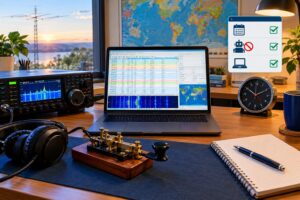
- Pre-peak shakedown: One or two evenings before Nov. 17, verify WSJT-X, rig control, audio, PTT, antenna switching, and logging.
- Peak window: Operate across the hours around the predicted maximum, especially when the Leonid radiant is favorably placed for your location.
- Post-peak follow-up: Continue into the following morning or evening. Meteor activity does not stop sharply at the published peak.
For many northern-hemisphere operators, meteor scatter activity is often productive in the pre-dawn hours because the observing location is moving into the meteoroid stream. With the Leonids, the radiant in Leo rises late and is better placed later in the night. Still, do not ignore evenings: random meteors, long-path geometry, and coordinated schedules can produce contacts outside the textbook “best” hours.
6 Meters vs. 10 Meters: How to Choose Your Band
6 meters: the primary MSK144 band
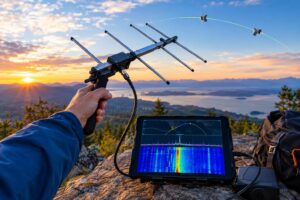
If you have a 50 MHz-capable transceiver, reasonable feed line, and even a small directional antenna, make 6 meters your main Leonids MSK144 band. A three- to five-element Yagi at modest height can be very effective, but loops, Moxons, and other horizontal antennas can participate. Keep expectations realistic: antenna pattern, takeoff angle, local noise, and path geometry all influence results.
Use current band plans and event guidance to select operating frequencies. Do not assume that a frequency mentioned in an old article is still appropriate or clear. Before transmitting, listen or decode, check for local usage, and follow your license privileges.
10 meters: useful, but interpret carefully
On 10 meters, MSK144 can be productive during meteor activity, especially when operators coordinate times and calling areas. However, 28 MHz is also a band where other propagation modes may appear. If you see long, steady decodes or broad regional openings, you may be working a mix of mechanisms rather than pure meteor scatter.
Technician, General, Amateur Extra, and other license classes have different privileges on 10 meters. U.S. operators should verify the current FCC rules for data emissions and frequency segments before operating. International operators should check their national allocation and band plan.
WSJT-X Setup Checklist for MSK144
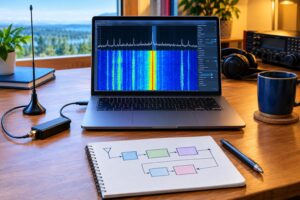
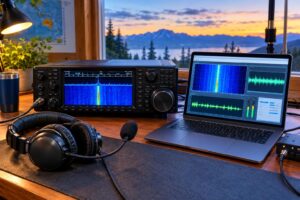
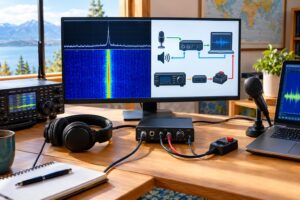
Install a current stable version of WSJT-X from the official project site, then configure it before the shower. Avoid making first-time changes during peak activity.
- Enter your call sign and grid square. A correct four-character grid is essential for standard MSK144 exchanges.
- Set the mode to MSK144. Confirm the waterfall, message panel, and decoding controls change accordingly.
- Use accurate computer time. Enable a reliable time-sync method so your clock stays within a small fraction of a second if possible. Poor timing causes missed decodes and broken sequences.
- Confirm CAT control or manual frequency discipline. Your radio and WSJT-X must agree on band, mode, and audio path.
- Use USB or data mode as appropriate for your radio. Follow your transceiver manual for digital audio operation.
- Set transmit audio conservatively. Avoid ALC action, overdriven audio, RF speech processing, compression, and equalization intended for voice.
- Enable standard messages and auto-sequencing only after you understand the flow. Auto-sequence is helpful, but you remain responsible for transmitting correctly.
- Log UTC, band, frequency, grid, and notes. Include whether the QSO appeared burst-like, sustained, or mixed with other propagation.
Use 15-second transmit/receive periods unless current event instructions specify otherwise. Coordinate “first” or “second” sequence when scheduling. If both stations transmit in the same period, neither station will copy the other. For random calling, follow normal regional practice and watch how active stations are sequencing before joining.
Clean Transmit Audio and Duty Cycle Matter
MSK144 is not a casual microphone mode. Your transmitter should produce a clean digital signal without splatter or distortion. Set the radio for the proper digital input, reduce computer output, and increase drive only to the point needed for the intended RF power. If the ALC meter moves heavily, back down. Turn off speech processing. Keep equalizers flat or disabled.
Digital meteor scatter can involve repeated 15-second transmissions. That is a demanding duty cycle for some radios, amplifiers, power supplies, and antennas. Verify that your equipment is rated for the power level and mode. A conservative, clean 50 watts is usually better than a distorted high-power signal that creates interference and overheats gear.
Antenna Direction and Practical Station Strategy
For scheduled QSOs, point toward the other station or toward the expected common reflection region along the path. For random calling on 6 meters, many operators aim toward population centers or likely activity areas rather than constantly turning the antenna. If you have a rotator, move deliberately; if you have a fixed antenna, pick a useful broad coverage direction and operate patiently.
Horizontal polarization is common for weak-signal VHF work in North America, including 6-meter meteor scatter. On 10 meters, many stations use whatever efficient antenna they already have. Vertical antennas may work, but polarization differences and local noise can matter. The best antenna is the one that is resonant, safe, reasonably efficient, and available when the shower arrives.
Standard MSK144 Exchange Example
A typical WSJT-X-style meteor scatter exchange uses call signs, grid squares, signal reports, acknowledgments, and 73. Exact formatting depends on the software and current operating practice, but the logic is usually:
- CQ message: CQ K1ABC FN42
- Reply: K1ABC W9XYZ EN52
- Report: W9XYZ K1ABC +03
- Roger report: K1ABC W9XYZ R+02
- Confirmation: W9XYZ K1ABC RRR
- Closing: K1ABC W9XYZ 73
Do not improvise long free-text messages during weak meteor scatter conditions. The structured messages exist because bursts are short. If you are participating in a special activity, follow its exchange instructions. If the activity asks for grid squares, do not substitute a state abbreviation unless that is explicitly part of the exchange.
Logging for Operating Value and Possible Science Value
Good logs are useful even when no formal reporting is required. Record the UTC date and time, band, frequency, worked station, grid, sequence, signal reports, and antenna direction. Add short notes such as “short pings only,” “several long bursts,” “possible Es,” or “sustained decode.” These notes help separate meteor-scatter behavior from other propagation later.
If HamSCI or another group provides a reporting format for the 2026 activity, follow that format rather than inventing your own. Citizen-science value depends on consistent timekeeping, location data, and honest reporting. Do not “clean up” logs to make them look more impressive.
Troubleshooting Before the Shower Peak
- No decodes: Check time sync, audio input device, receiver mode, squelch settings, and whether the band is actually active.
- Others decode you poorly: Reduce transmit audio, check ALC, verify frequency, and confirm your clock.
- Rig does not transmit: Test CAT/PTT settings, data mode selection, audio routing, and interface cabling.
- RF gets into the computer: Add ferrites, improve station grounding/bonding, reduce power, and separate RF cables from USB and audio leads.
- High SWR: Stop and fix the antenna or feed line. Do not use the shower peak as a reason to abuse equipment.
Safety and Regulatory Caveats
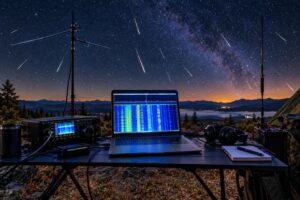
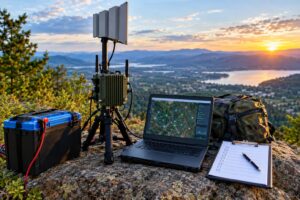
Follow your license privileges, national regulations, and current band plans. In the United States, also consider RF exposure compliance, especially on 6 meters and 10 meters with directional antennas or amplifiers. Keep people away from active antennas, use proper mast hardware, avoid overhead power lines, and disconnect outdoor antennas during lightning risk. Portable operators should secure masts, manage batteries safely, and avoid operating in unsafe weather just to chase a peak hour.
Key Takeaways
- Check the current IMO calendar for the 2026 Leonids peak timing and convert it to local time.
- Use 6 meters as the main MSK144 meteor scatter band if your station supports it; add 10 meters if you can operate legally and cleanly.
- Configure WSJT-X, clock sync, audio levels, PTT, logging, and antenna switching before Nov. 17.
- Use short, standard exchanges and disciplined 15-second sequencing.
- Log honestly, including notes about possible non-meteor propagation.
FAQ
Do I need a large 6-meter Yagi for the Leonids?
No. A directional antenna helps, but many operators start with modest antennas. A clean station, accurate timing, and good operating habits often matter more than maximum gain.
Can I use FT8 instead of MSK144?
FT8 may make contacts on 6 or 10 meters when propagation supports it, but MSK144 is specifically designed for fast meteor-scatter bursts. For Leonids meteor scatter activity, MSK144 is the more appropriate choice.
Is every 10-meter MSK144 contact during the Leonids meteor scatter?
Not necessarily. Ten meters can support several propagation modes. Use burst behavior, timing, path, and band conditions as clues, but avoid overclaiming certainty.
Where should I verify dates and software details?
Use current primary sources before the event: the International Meteor Organization meteor shower calendar, NASA’s Leonids overview, the official WSJT-X page, and HamSCI’s MSK144 activity guidance.