Solar Cycle 25 Is Changing the 10m and 6m Game
Solar Cycle 25 ham radio propagation is no longer just a story about “the bands are back.” As NOAA and NASA’s solar-cycle pages were updated in November 2026, the practical message for operators is that Cycle 25 is near, at, or past its broad maximum. That does not mean 10 meters and 6 meters are finished. It means the easy, all-day openings become less dependable, and smarter band selection matters more.
The mistake is treating 10m and 6m as either “open” or “dead.” Both bands can produce excellent contacts during the downslide, but they often open by different mechanisms, at different times, and with shorter warning. If you use current solar and geomagnetic data before calling CQ, you can avoid wasting an afternoon on a dead band while still being present when the band cracks open.
For current context, use primary data pages such as NOAA Space Weather Prediction Center’s Solar Cycle Progression, NASA’s Solar Cycle Progression and Forecast, NOAA’s Predicted Sunspot Number and Radio Flux, and background reporting such as Radio World’s Solar Cycle 25 coverage for amateurs and shortwave listeners.
The Data That Actually Helps Before You Transmit
Solar data can look intimidating, but a small set of numbers tells you most of what you need for upper-HF and low-VHF operating.
Solar flux and sunspots
The 10.7 cm solar radio flux, often called SFI or F10.7, is a useful broad indicator of ionization. Higher flux generally supports a higher maximum usable frequency, especially on paths exposed to daylight. Sunspot number is related, but it is not a minute-by-minute operating tool. Think of flux and sunspots as the climate of the band, not the local weather.
For 10 meters, sustained higher solar flux can support F2-layer propagation on north-south, east-west, and transoceanic paths. For 6 meters, ordinary F2 propagation is much rarer, but strong cycle conditions can occasionally lift the MUF high enough for remarkable openings. As Cycle 25 declines, those 6m F2 chances become less common, while 10m can remain worthwhile on good days.
Kp, geomagnetic activity, and aurora risk
Kp is a planetary geomagnetic index. Low Kp usually favors stable F-layer propagation. Rising Kp can disrupt polar and high-latitude paths, reduce upper-HF reliability, and make a promising 10m day collapse quickly. On the other hand, disturbed geomagnetic conditions may create auroral opportunities on 6m for operators in suitable latitudes, though auroral signals are often raspy and better suited to CW, SSB, or specialized digital approaches than casual ragchewing.
X-ray flares and absorption
Solar flares can cause sudden shortwave fadeouts on the sunlit side of Earth. If 10m was lively and suddenly disappears, check the X-ray and alert products before blaming your antenna. A flare-driven fadeout can make upper HF sound broken for a while, even though the station is fine.
MUF clues
The maximum usable frequency is path-specific. A map or prediction that suggests a high MUF over one region does not guarantee your exact path will work. Still, MUF trends help decide whether to start on 10m phone, try 10m FT8, park on 6m, or move lower.
A Practical Decision Flow for 10 Meters
Ten meters is the main beneficiary of the solar-cycle peak and early decline. It is high enough to feel the downslide quickly, yet low enough that good F2 openings can continue well after maximum.
When 10m deserves your first call
- Solar flux is supportive and has been reasonably steady for several days.
- Kp is low to moderate, especially for polar or high-latitude paths.
- The path is in daylight or near gray-line enhancement for the regions you want.
- Beacon networks, spotting networks, or PSK/FT8 activity show real signals on nearby paths.
- Lower bands are strong but crowded, making 10m an efficient alternative.
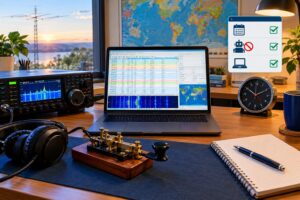
A good operating sequence is to check current solar flux and Kp, listen to 10m beacons or FT8 activity, call briefly on a mode appropriate for conditions, then reassess. If there is no trace of signals, do not call endlessly into silence. Move to a more likely path, mode, or band and return later.
Mode selection on a fading solar cycle
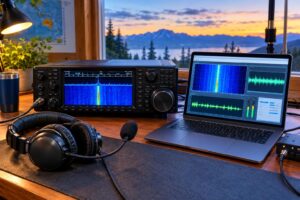
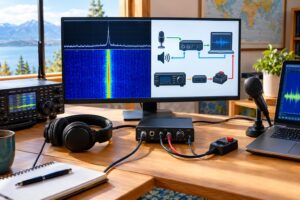
As the cycle declines, 10m openings often become thinner. SSB remains excellent when signals are strong, but CW and digital modes can reveal openings before voice becomes practical. FT8 is not magic, but it is an efficient propagation detector because many stations are watching the same small slice of spectrum. If FT8 shows decodes from the target region, try CW or SSB if signal levels support it.
For a simple example, suppose you are in the central United States on a winter morning. Solar data looks favorable, Kp is quiet, and you see 10m FT8 decodes from the Caribbean and South America. That is a rational time to try 10m SSB or CW toward the south. If there are no decodes, no beacons, and no waterfall traces, it is better to check 12m, 15m, or wait for the sun angle to improve.
How to Keep 6 Meters Realistic
Six meters is called the “magic band” because openings can appear suddenly, not because it ignores physics. During the Cycle 25 downslide, 6m operating should be based on multiple propagation modes rather than waiting only for classic F2.
Sporadic E remains the everyday opportunity
Sporadic E, or Es, can support strong 6m openings even when solar flux is not impressive. In North America, Es is most associated with late spring through summer and a smaller winter season, but exact timing varies. Es clouds are patchy, so one operator may work several states while another 100 miles away hears little.
Use 6m FT8, beacons, and regional reports as early warning tools. If short-skip signals appear at 400 to 1,200 miles, consider switching to SSB or CW while the opening is strong. Do not assume a quiet band at noon means the whole day is lost; Es can develop and vanish quickly.
Trans-equatorial propagation
Trans-equatorial propagation, or TEP, can support 6m paths crossing the geomagnetic equator, often favoring north-south paths and certain afternoon or evening windows. TEP is geographically selective. A station in Florida, Texas, or the Caribbean may have more practical access to some TEP paths than a station far north. Solar-cycle strength helps, but geometry matters.
Aurora and disturbed conditions
If geomagnetic activity rises, 10m F-layer paths may degrade, but 6m aurora may become possible for stations at suitable latitudes. Point antennas generally northward in the continental United States for auroral scatter, and expect distorted audio. CW often cuts through better than SSB. Observe your license privileges and band plans, and remember that auroral operation is not a substitute for normal local emergency communication planning.
Meteor scatter as the dependable fallback
Meteor scatter is not dependent on solar maximum in the same way F2 propagation is. Digital meteor-scatter modes such as MSK144 are commonly used on 6m by operators with appropriate software, timing discipline, and station setup. Random meteors can work, while major showers may improve odds. This is a better plan than staring at an empty waterfall waiting for rare F2.
Do Not Confuse “No Spots” With “No Propagation”
Spotting networks are helpful, but they are not the ionosphere. A band may look dead simply because no one is transmitting from your area toward the path you care about. Conversely, a cluster full of spots from another region may not help your location.
Use spots as one input. Pair them with actual listening, your own decodes, beacon reception, and solar data. On 10m, a lack of spots during a favorable solar day may be an invitation to call CQ. On 6m, a sudden burst of decodes from one direction deserves immediate attention because the opening may be short.
Station Setup That Helps Without Overbuilding
You do not need an extreme station to benefit from Cycle 25’s remaining upper-band opportunities, but small improvements matter.
- For 10m: A resonant vertical, dipole, loop, or small directional antenna can all work. A rotatable beam helps, but it is not mandatory.
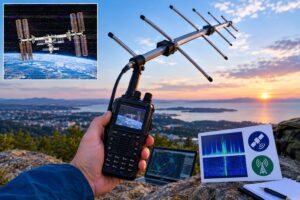
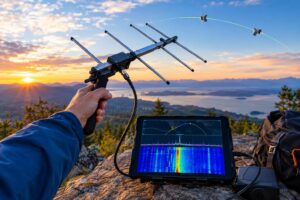
- For 6m: A modest horizontal loop, Moxon, or small Yagi often improves results dramatically compared with a compromised multiband HF antenna.
- Feed-line loss matters more on 6m than on lower HF. Use decent coax, keep runs reasonable, and weatherproof outdoor connections.
- Keep receiver noise low. A noisy power supply, LED lamp, solar charger, or computer accessory can make a marginal opening invisible.
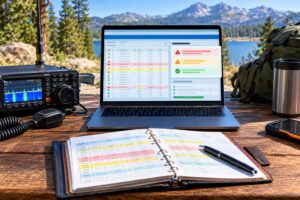
- Log what did not work. Date, UTC time, solar flux, Kp, band, mode, and heard regions will teach you your local patterns.
For antennas, follow safe installation practices. Maintain clearance from power lines, secure masts properly, account for wind loading, and disconnect or protect equipment during lightning risk. Also evaluate RF exposure compliance for your power level, antenna gain, duty cycle, and operating distance. Technical capability does not override FCC rules, local ordinances, HOA restrictions, or the privileges of your license class.
A No-Chase Operating Plan
The goal is not to camp forever on a silent band. The goal is to sample intelligently.
Morning
Check solar flux, Kp, and alerts. If conditions are quiet and solar support is decent, sample 10m toward sunlit east-west or north-south paths. Use FT8 or beacons as a quick probe, then move to CW or SSB if signals support it.
Midday and afternoon
Watch for 10m F2 strength and 6m Es. In Es season, 6m may become the better band even if 10m sounds ordinary. If 6m decodes appear in clusters from one region, act quickly.
Evening
Try north-south 10m paths while daylight remains over the midpoint or target area. In suitable geography, consider TEP windows. If geomagnetic conditions are disturbed and you are far enough north, listen for 6m auroral signals.
When to quit
If current data is poor, Kp is elevated, there are no signals, and your calls produce no replies after a reasonable trial, move down in frequency. Fifteen, 17, 20, or 30 meters may provide better results. Leaving 10m or 6m is not failure; it is good operating.
Key Takeaways
- Cycle 25’s downslide does not kill 10m and 6m, but it rewards operators who use current solar and geomagnetic data.
- Ten meters remains the best upper-HF band for F2 openings as solar support gradually weakens.
- Six meters needs a broader strategy: Es, TEP, aurora, and meteor scatter all matter.
- Low Kp usually helps ordinary F-layer paths; disturbed conditions may hurt HF but create auroral VHF chances.
- Use FT8, beacons, and spots as propagation indicators, not as proof that a band is universally open or closed.
- Keep safety, RF exposure, licensing, and local installation rules in the plan.
FAQ
Is 10 meters still worth checking after solar maximum?
Yes. Ten meters often remains productive into the declining side of a solar cycle, especially on days with supportive solar flux and quiet geomagnetic conditions. The difference is that openings may be less frequent, shorter, or more path-specific.
Does a high solar flux guarantee 6m F2?
No. High solar flux improves the odds of higher MUF, but 6m F2 is still uncommon and path-dependent. Treat it as a bonus, not the foundation of your 6m plan.
What is the fastest way to tell if 6m is alive?
Check local receiver noise first, then monitor 6m FT8, beacons, and regional reports. If you see multiple decodes from similar distances or directions, there may be an Es or other opening worth pursuing.
Should I call CQ on a quiet band?
Briefly, yes, if the data supports a possible opening. But do it with a plan: call for a few minutes, listen carefully, try a sensitive mode, and move on if there is no evidence of propagation.